Parents, braille will be much harder for your students to obtain.

Hi everyone, I’m devastated that the Trump administration’s anti- diversity, equity, and inclusion policies target people with sensory loss. The Department of Education recently used the policy to cancel grants that funded our nation’s major braille training programs. No training = Less braille access.

  • DIVERSITY: Blind, low vision, and DeafBlind students represent diversity in the general student population.
  • EQUITY: Blind students have the right to receive educational materials in accessible formats such as braille.
  • INCLUSION: Our students have the right to be included in all aspects of public life and community.
  • The Department of Education is using these DEI terms to cancel grants that serve our community! We can’t let that happen!

You may remember, that I fought a vicious battle to obtain braille for Kai’s high school math and science classes. We ‘won’ in mediation, and Kai got what he needed, and we made braille access easier for all students in our district, but now the nation’s current and future braille readers are at risk.

BELOW IS THE INFORMATION YOU NEED TO KNOW

Continue reading “Parents, braille will be much harder for your students to obtain.”

A Great Resource for Transition-Age Youth with Visual Impairments

Transitions are hard for everyone, but can be especially fraught with anxiety for blind and low vision students and their parents. I’m excited to introduce you to a valuable resource that can help. MEET EMPOWER VI!

I’ve had the pleasure of contributing two video segments to their program. And I appreciate that they are committed to sharing a variety of perspectives on important topics.

The video below is me discussing the importance of allowing my blind son Kai to take risks. It’s titled, Kim Owens: The Dignity of Risk. It is part of a free course that parents can access by clicking here. If you take the free course, please also take the survey at the end. The data is important in supporting this work.

The next video is me sharing about our choice to send Kai to a local public school instead of the state’s school for the blind. It’s titled, Kim Owens: Public School Perspective. It is part of a free course that can be accessed by clicking here.

To check out more videos like these, visit the EMPOWER VI YouTube channel!

LEARN MORE ABOUT EMPOWER VI
At EMPOWER VI our goal is to support transition-aged students with visual impairment, especially those in rural communities, by providing the tools, resources, and community they need to succeed after high school.

Whether you’re a student, a family member or a professional, we offer free, virtual resources that help bridge the gap between high school and what comes next, including postsecondary education, employment, and independence.

Continue reading “A Great Resource for Transition-Age Youth with Visual Impairments”

Use Your Voice: Advocacy Strategies for Children’s Vision

Did you miss the Eye Health and Vision Resources for Parents and Caregivers Webinar?
Guess what? You can watch my presentation by clicking here.

ID: 2 adults with 2 young children on their backs.

Hi, It’s Kim and I’m thrilled to announce that I’ll be presenting at the upcoming Use Your Voice: Advocacy Strategies for Children’s Vision FREE webinar!

Join Prevent Blindness and the National Center for Children’s Vision and Eye Health on Wednesday, June 4, 2025, from 2:00 p.m. until 3:15 p.m. ET for a 75-minute webinar Use Your Voice: Advocacy Strategies for Children’s Vision. In this webinar, participants will gain a deeper understanding of the advocacy process; the value and impact that individual and community voices have on the advocacy process; and how to effectively advocate for public policies that govern health care, eye care, and school systems to ensure responsiveness to children’s vision health needs.

Register HERE

This webinar will explore the following topics:

Continue reading “Use Your Voice: Advocacy Strategies for Children’s Vision”

My 10-Year-Old Son Was Blind and No One Knew!

Hi, it’s Kim and I want to tell you about an important piece of legislation called the Early Detection of Vision Impairment (EDVI) Act. Did you know that public school children receive federally funded hearing screenings? The EDVI Act would provide vision screenings, too!

Why is this important? Well…

My 10-Year-Old Son Was Blind and No One Knew!

In first grade, I noticed that my son kept pushing on his eyes and pulling at the lateral corners. Eventually, the area around his eyes became bruised. The doctor said it was allergies and prescribed over-the-counter medicine, but it got worse. Click here to read my full essay about the EDVI Act.

Want to know more? You’re in luck! I recently had the opportunity to chat with Julie Grutzmacher, Director of Patient Advocacy and Population Health Initiatives at Prevent Blindness. In our discussion, we talked more about EDVI and I shared a list of questions I wished I had asked Kai’s first eye doctor. Check out Episode 2 of the Focus on Eye Health podcast hosted by advocate Christopher Hord. Click here to listen.

Would you like to support the EDVI legislation? Click here to learn how you can help because your voice matters! And if you’d like to start using your experience and voice for change, please check out the the ASPECT Patient Engagement Program. I learned how to confidently and succinctly share my family’s story to a wide-range of audiences. I had years of experience mentoring other families, and the IEP process gave me plenty (read: more than enough!) opportunities to advocate for my son’s accommodations, but ASPECT gave me the tools to push for change on a state and national level. I highly recommend this program to anyone who wants to tap into a powerful community of change-makers and flex their advocacy muscles.

Do you want to become a stronger blindness advocate? If so, click here to learn more and apply. Be sure to tell them Kim Owens sent you!

2023 Family Year-End Update

Hi everyone, Hope you are well. Blog updates are few and far between these days as Kai is living his best life as a junior in college! His major is music theory and his minor is jazz drumset. The college is still fulfilling all of his accommodations and he’s really happy at UGA.

Kai and his guide dog Pride have hit their stride together as a working team and Kai loves the companionship. He says that other students saw his cane as a barrier to conversation but Pride is a conversation magnet and his social life is going strong. He has recently taken over as leader of a jazz consortium in Athens, Georgia called Swing Theory. A group of local jazz performers who get together to jam and gig at local venues. You can read more about it by clicking here.

Kai and Pride live with two roommates just off campus. They can easily walk to campus and then use the university’s transit system to get to class. If the weather is terrible or he needs to be someplace early, the university sends a paratransit van to assist. He’s still encountering some unfortunate discriminatory issues with rideshare (you can read more about that here) but otherwise no complaints.

Continue reading “2023 Family Year-End Update”

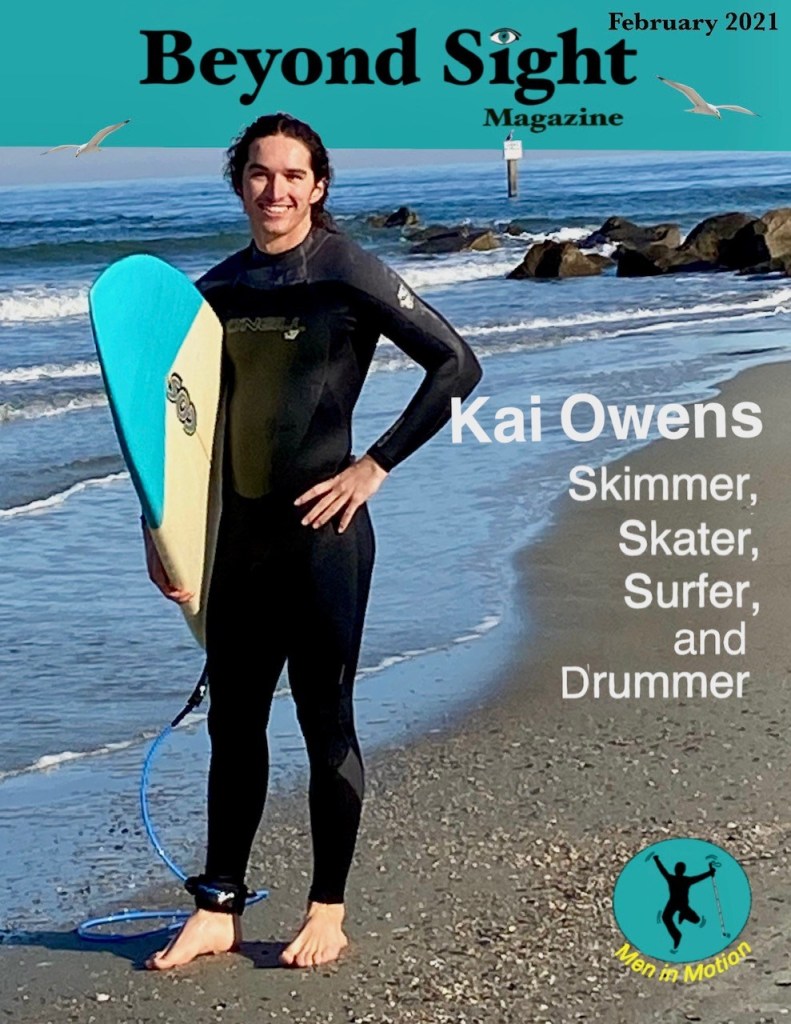
Kai is Featured in Beyond Sight Magazine’s Men in Motion

We’d like to thank the fabulous team over at Bold Blind Beauty for choosing Kai to be featured in Beyond Sight Magazine’s Men In Motion. Below is a bit about their online magazine and a link to Kai’s feature article and video.

From Beyond Sight: In 2021 we will be introducing you to incredible young people like Kai Owens who are doing extraordinary things. These young people are extraordinary because in spite of the barriers they encounter daily they persist. Many have learned from an early age to self-advocate and the strength, resilience, and tenacity they possess will change perceptions.

Click here to watch his video on YouTube.

Click here to visit Kai’s feature page which includes a video of him telling a bit about his life.

Beyond Sight Magazine Cover featuring Kai standing on a beach. He’s wearing a wet suit and holding his surfboard.

“…It’s all just about finding what you like, and not letting anyone hold you back or other people’s notions about you hold you back.”

Kai Owens, 18

It Takes a Village: Even in a Pandemic.

As the pandemic throws curve ball after curve ball and families and schools struggle to  adapt we, at Navigating Blindness, are excited to launch our new series entitled “It Takes a Village.”  Today we will hear from Sarah Immerfall as she explains what her son’s village looks like in the midst of a pandemic.

We’d love to hear from you too. If you’d like to share your story, please reach out for specifications using our contact form. Thank you!

Guest Post by Sarah Immerfall

Hi! My name is Sarah and my son, Siah, was born completely blind. He has a condition called Oculoauriculovertebral Syndrome that caused microphthalmia and he wears bilateral scleral shells. He just turned 4 and is finally past a lot of medical treatment for issues unrelated to his vision, and we are so excited to focus solely on his progress! Continue reading “It Takes a Village: Even in a Pandemic.”

Navigating My Blindness by Kerry Kijewski

We love featuring stories of people making a difference in the blindness community. Kerry and her brother Brian are making waves – radio waves – on their show Outlook. We hope you enjoy Kerry’s post about growing up with sight loss and finding her voice in advocacy.

Guest post by Kerry Kijewski

In disability activist Judy Heumann’s book Being Heumann: An Unrepentant Memoir of a Disability Activist, she says she believes she was meant to have a mother who would not give up on her daughter who was born with a physical disability. I don’t know about that in my case, but I do know I am lucky to have been given the advantages and foundation from my parents. I recognize my privilege, having them firmly in my corner.
This doesn’t mean I have it all figured out (no matter how much I wish I did), even as I am staring down forty in a few short years. I am further along because of the support I grew up with and still count on today. Continue reading “Navigating My Blindness by Kerry Kijewski”

Aille Design: Clothing that Speaks

July is braille literacy month on Navigating Blindness and today we are excited to feature Alexa Jovanovic, founder of Aille Design!

By Alexa Jovanovic, Founder of Aille Design

Braille is much more than a communication tool. It enables freedom of expression, provides independence and increases literacy. When combined with mainstream fashion, it symbolizes the importance of inclusive representation in the fashion industry and empowers communities to advocate for social justice. Continue reading “Aille Design: Clothing that Speaks”

We Are Not Blind To Injustice. The 2020 College Board Experience.

July is braille literacy month on Navigating Blindness and we are excited to feature high school student Kaleigh Brendle who successfully advocated for Braille accommodations on the 2020 College Board exams — globally!

Guest post written by Kaleigh Brendle, high school student. 

My name is Kaleigh Brendle. I am 17 years old, and since birth, I’ve possessed a condition called Lebers Congenital Amaurosis, which left me visually impaired.

Four of the courses I was enrolled in this past school year are classified as Advanced Placement, or AP, courses. The course curriculums and final exams are created and administered by a corporation called the College Board. This corporation also presides over the PSAT and SAT exams, among others. Under normal circumstances, I receive all my College Board exams in Braille, and before the onset of the pandemic, the AP exams were going to be no different. If I performed well enough on these high-stakes tests, I may receive college credit for the completion of the course. Thus, these exams are extremely influential. Many blind and deaf-blind AP students had Braille specifically stated in their accommodation plans. However, due to the Covid-19 pandemic, the College Board was forced to shorten and digitize their exams. In doing so, they communicated to us that Braille would not be provided this year. For exams that feature maps, coordinate planes, and other highly visual graphics, a “No-Braille” decision meant that these images would not be embossed. One of my courses, AP Biology, is extremely diagram-heavy, so I grew concerned about the prospect of not possessing the visuals in hard-copy format to tactilely navigate. According to the College Board’s website, 65% of my exam score would be dependent upon my ability to successfully interpret a single graphic. The solution that College Board provided was something called Alternative Text, a description coded into an image or graphic so that a student’s talking software will read the written text when their cursor encounters the image it describes. So when an image of, say, a phospholipid bilayer appears on my screen, my software will start speaking at me and reading the description. It became not so much how well I could interpret the image, but how much of that description I could memorize. If a graph appeared on the screen, it would read out every point on the graph, even spelling out the word “comma”. The given student would be inundated with details. We tried to explain to the College Board that providing us with a large block of text was not a substitute for the actual graph. We need that spatial information as anyone else would; the College Board executives were adding another cognitive burden to an already stressful situation. In addition, with the exams being administered through technological mediums, I sought to clarify what would transpire if a glitch were to occur with my accessible software. For instance, what if VoiceOver does not read the question? What if Jaws shorts out my computer during the exam? When posing this question, the response I received was troubling. I was informed that however long it took me to resolve a tech glitch in my exam, I would have that much less time to complete it. If it took me forty-five minutes to resolve an issue, and the exam was an hour in length, I would have fifteen minutes. The suggestion of both a representative and an executive that I spoke to about this was “use a device with less problems”. Unfortunately, in the world of accessible technology, it is impossible to anticipate what devices will pose complications on that given day. Continue reading “We Are Not Blind To Injustice. The 2020 College Board Experience.”